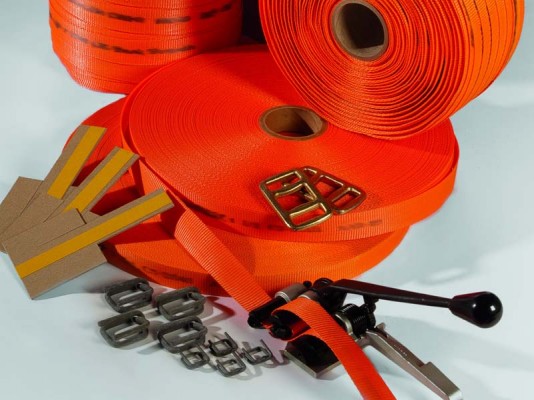
System Strength of Synthetic Cord Strap

When trying to determine the proper strength of synthetic cord strap needed in your load plan there are two types of measurements commonly referred to – Break Strength and System Strength – but what do these mean? Below are descriptions of each of these terms and why they are just some of the important terms to know when trying to decide which type of synthetic cord strap you need to secure your cargo.

Break Strength (also referred to as Tensile Strength):  The Break Strength of synthetic cord strap is the amount of force (commonly measured in pounds or dekanewtons) that a piece of strap can withstand before breaking and/or splitting. The Break Strength of strap is used to determine the strength of the synthetic cord strap alone, without the addition of a buckle (i.e. Joint Efficiency).

Joint Efficiency: Joint Efficiency is a percentage of the strap strength with the incorporation of a wire buckle or ladder buckle. The Joint Efficiency is critical when trying to calculate the System Strength.

System Strength: System Strength is the force (commonly measured in pounds or dekanewtons) required to break a unit of strap. This consists of one loop of strap and one buckle used to connect the ends of the strap, forming a “belt loop”. The System Strength can be found by multiplying two times the Break Strength of the strap by the Joint Efficiency of the buckle (Ex. System Strength = (Break Strength x 2) x Joint Efficiency).

Below is a diagram of the different types of measurements being tested.

When trying to obtain the proper System Strength of your strap, it is important that the same strap and compliant buckle combo are being used that was originally tested to achieve the AAR approval. Using an unapproved strap and buckle combination can lead to a different System Strength and cause your load to be non-compliant. The approved strap and their corresponding buckle can be found on the AAR’s website in Table 19.2 of the AAR’s Open Top Loading Rules. The list of AAR approved strap for doorway protection can be found in the AAR’s publication “Nonmetallic Strap Substitution for Steel Strap as Doorway Protection in Boxcars”.

Please note, not all the factors that need to be considered when choosing a strap for your load plan were mentioned in this blog. Understanding Break Strength, Joint Efficiency and System Strength will provide you with a good start on your search for your cargo strap. For more information about the strength of synthetic cord strapping and the corresponding buckles, speak to one of our knowledgeable technical sales and services representatives by calling us toll free at 866-858-8800.

If you liked this blog, you may also like:

Woven Vs. Composite Strap – The Differences Between the Two

Railcar Doorway Securement – Change to Rule 7 of AAR’s Circular No. 42-K

Threading a Wire Buckle

Woven Vs. Composite Strap

Two of the most popular types of strap used in the cargo securement industry are polywoven and composite. Both are great products to use when securing your cargo, but there are differences between the two that make each one more suitable for certain load applications.

Polywoven strap is made up of polyester fibers that are woven together. Its strength comes from the way the fibers are woven in a multi-directional pattern, weaving both horizontally and vertically. The composition of polywoven strap allows it to have flexibility while providing good tension on rigid loads. The woven material provides slight elongation of the strap, helping it absorb some of the shock and impact during transit while still maintaining its position.

Composite strap is made up of strands of polyester fibers, all traveling vertically and coated together by clear polypropylene. The polypropylene coating increases its resistance to abrasion, yet still allows for slight elongation during transit. Due to its polypropylene coating, composite strap is much stiffer than polywoven strap. The stiffness of composite strap makes it easy to feed underneath pallets.

Both woven and composite strap have different wire buckles that are intended to be used with each type of strap. The difference is the finish on the buckles. For woven strap, you should use phosphate coated wire buckles. The phosphate coating on the buckle allows for more friction against the woven material. If composite strap were used with the phosphate coated wire buckles, the strap would become worn from the friction between the buckle and strap. Instead, for composite strap you should use galvanized wire buckles. The smooth finish of the galvanized buckle allows the composite strap to thread effortlessly on the buckle and stays in place because of the stiffness of the strap. If woven strap were used with the galvanized buckles, the strap could slip off the buckle as there would be no friction between the buckle and strap to hold the strap in place.

In order to get the maximum effectiveness from your cargo securement products, it is important the correct products are used together. To find out more about the products you should be using in your load plan contact us toll free at 866-858-8800.

Are You Still Using Steel Banding? 5 Reasons Why You Shouldn’t Be.

Do you want to enhance workplace safety?

Do you want a cost-effective strapping solution?

Are you still using steel banding?

Traditional steel banding has long been the industry standard and is still in widespread use today. You may be using steel banding to secure your heavy-duty cargo because it’s what you are familiar with.

But steel banding is no longer the only choice.

Through technological advancements, synthetic cord strapping/lashing has become as strong and reliable as steel – but with fewer risks and costs. In my experience, synthetic strapping alleviates many of the common problems with steel strapping without any major drawbacks.

So ask yourself: why you would continue to use steel banding when a superior option is available?

I will explain the key reasons why you should switch from steel strapping to synthetic cord strapping based on an analysis of the benefits of synthetic strapping.

1. Synthetic Strapping is Less Expensive

Steel banding is more costly than synthetic cord strapping. Furthermore, steel banding can be difficult to budget for because the cost can change based on the price of the base metal.

Synthetic strapping is more cost-effective and the price remains stable, so you will always be able to factor it into your budget with confidence.

2. Synthetic Strapping is Safer

Even when smoothed and de-burred, steel banding can be a safety hazard. All it takes is a moment of carelessness, and even an experienced employee can be injured. When a tightened steel band is cut improperly, it releases with strength. Its sharp edges can cause deep gashes on the user, particularly on the face.

Synthetic cord strapping is made of polyester, addressing this safety hazard. Securing cargo with synthetic strapping and lashing reduces lost-time accidents and injuries. Not to mention, fewer injuries = fewer liability claims.

3. Synthetic Strapping is Ergonomically Friendly

On average, steel banding coils weigh about 100 pounds. Many users struggle with loading these heavy coils into the dispenser. The weight of the steel can cause an accident that leads to an injury, or create a built-up strain injury over time.

Synthetic strapping/lashing is lighter and easier to handle. Each coil weighs only 50 pounds on average, which is much more manageable for the user.

4. Synthetic Strapping Won’t Damage Your Cargo

Scratches. Tears. Rust. Stains. Steel banding can damage your cargo, particularly if you’re transporting anything with exposed paint, vulnerable surfaces, or tires.

Synthetic strapping has rounded edges that don’t scratch paint or damage loads. It won’t rust or stain your cargo, either.

5. Synthetic Strapping Conforms to Settling Loads

Once applied, steel banding does not stretch. If your load settles while in transit, your steel banding will no longer be wrapped tightly around it. This leads to shifting loads, potential damage, and safety hazards. I have often seen pallets with loosely hanging steel-banding after the load has settled.

As you may expect, synthetic strapping stretches. If your load settles, synthetic cord strapping will simply conform to the new load perimeter and continue to hold tightly.

The Bottom Line

Steel banding is rapidly becoming an outdated form of cargo securement. Synthetic cord strapping/lashing is superior, while maintaining the strength necessary for heavy loads.

>> Get Tex-Steel synthetic cord strapping/lashing from Complete Packaging Systems – it’s as strong as steel and suitable for railcar, truck, or ocean containers! Contact us today.

Like this? You might also like:
Tex-Steel™: A Cord Strap as Strong as Steel
Why You Should Use Rubber Friction Mats to Secure Your Shipments
AAR Approved Method – Threading Tex-Steel into Boxcar Wall Anchors [VIDEO]