Happy Holidays from Complete Packaging Systems!

CPS holidays graphicDuring the holiday season, our thoughts turn gratefully to those who have made our success possible. It is in this spirit that we say thank you and best wishes for the holidays and New Year!

We hope your holidays are filled with joy and your travels, wherever they may take you, are safe.

We have included our Christmas hours below:

  • Dec. 24: 8 am to 12 pm
  • Dec. 25—28: Closed
  • Dec. 29—30: Normal Hours
  • Dec. 31: 8 am to 3 pm
  • Jan. 1—4: Closed
  • Jan. 5: Resume Normal Hours

Please let us know if there is something you may need prior to the holidays.

If you require immediate attention over the holiday breaks, please contact our toll free number: 1(866)–858–8800, and leave a message. Someone will respond to your inquiry as quickly as possible.

All of us here at Complete Packaging cannot stress enough how grateful we are for your continued patronage. We look forward to serving you in the New Year.

Check Out Our Previous Posts


See the Latest Railroad Safety Facts from the Federal Railroad Administration [Whitepaper]

The Federal Railroad Administration (FRA) released a great report about the state of railroad safety in the United States. The document, titled “Safety Fact Sheet”, discusses some good news!

Although railroads are carrying more goods and people than they have in a generation, the ten-year trend of accidents shows a definitive downward curve. Rail has never been safer – we’re seeing record-breaking levels of safety performance since 2008.

Here are some of the key stats:

  • 38% reduction in human factor caused accidents
  • 37% reduction in tract defects
  • 41% reduction in equipment defects

These are fantastic numbers for everyone involved in rail transport to celebrate.

Click here to download the Safety Fact Sheet from the FRA.

Of course, we must still work toward achieving ever-higher standards of safety on our railroads. Everyone plays a part in reaching that goal, from the FRA to the rail personnel unloading product.

If you ship goods via rail, using the proper cargo securement methods is paramount to safety. We know first-hand the importance of well-secured loads, particularly for heavy weight and high density loads such as paper rolls.

We encourage you to read the good news from the FRA, and think about ways you can improve safety in your own processes.

>> If you need quality cargo securement products, contact us now!

We also offer load consultation services to help increase safety and efficiency. Learn more here.

Like this? You might also like:

U.S. Protective Packaging Market to Reach $6.8 Billion in 2018

Protective packaging, including cargo securement for safety and damage prevention, is highly valuable and necessary for organizations transporting goods via rail, truck, or boat.

A recent market research study of the U.S. protective packaging market by Freedonia forecasts that the U.S. demand for protective packaging will reach $6.8 billion by 2018.

This increase is based on the continuing recovery of the manufacturing sector after the recession, as well as an increased prevalence of Internet shopping.

Dunnage bags, in particular, are expected to see moderate growth as the industry improves.

What Does This Mean for You?

Certain industries in particular will experience greater demand, which will result in the need to ship more product. It may also mean an increase in the amount of rail, truck, and boat traffic as the economy continues to improve.

This is great for business and cause for optimism in the manufacturing and shipping industries! However, as traffic increases, more product is shipped, and deadlines draw near, we must ensure that safety is at the forefront.

When loads are properly secured, product will arrive undamaged and personnel will be able to do their jobs safely.

Work with your cargo securement supplier – like us – to ensure that they’re informed of any increased volumes of production. That way, your supplier will be sure to manage stock accordingly so you will always have the products you need, when you need them.

>> Complete Packaging Systems provides cost-effective, high quality cargo securement products to Canadian and U.S. organizations, such as pulp and paper companies. Contact us to order products.

We also offer professional load planning services. Talk to a securement specialist now!

Like this? You might also like:

Welcome to Our New Website!

We are excited to officially announce the launch of the new Complete Packaging Systems website!

As you’ll see, we have redesigned our website to make it even easier for you to find what you’re looking for. We’ve broken out our products on the main navigation menu, so you will always be able to go to right page for exactly the product you’re interested in.

Visit our new product pages:

Furthermore, we added a new page explaining our load consultation service. At Complete Packaging Systems, our team of cargo securement specialists can help you optimize your load. We can help you design customized load plans for rail, truck, and boat transportation that are compliant with the latest safety legislation.

Please visit our new Resources page, which includes a variety of downloadable PDFs to provide you with any additional information you may need to make your cargo securement decisions. If you would like to suggest helpful documents to add to our library, we encourage you to contact us!

This blog, which began on our old site, will continue on this site to inform you of the latest news and tips in cargo securement best practices, load planning, and securement products.

So explore our new website and let us know what you think! We hope youÂ’ll find it easy to navigate and informative.

If you have any questions about our products or load planning, we encourage you to get in touch with us.

>> Complete Packaging Systems offers industry-leading cargo securement and damage prevention products. Contact us today!

Like this? You might also like:

Safety Warning! Make Sure You Know If Your Dunnage Bags are AAR Approved

Are your dunnage bags up-to-date with their AAR safety verification? If not, you are assuming significant risk, in the form of personal and public safety, damage, and the associated costs.

Many options are available for dunnage air bags. You may simply look for the best price or a local supplier who will provide easier access. However, you must not overlook whether the dunnage bags are approved for use on railways by the Association of American Railroads.

The Product Performance Profile for Pneumatic Dunnage (PPPPD) General Information Bulletin No. 9, approved by the damage prevention and freight claim committee of the AAR, explains the guidelines for dunnage bag approval. Developed with input from manufacturers, this document provides the acceptable confidence level for use of dunnage bags for shippers, vendors, and transportation carriers.

 Click here to download the PPPPD General Information Bulletin No. 9. 

Beyond outlining the performance requirements for approval, the document details the re-verification requirements and procedures for after test failures. Today, we must concern ourselves with the re-verification requirements; we encourage rail shippers to periodically check the AAR website to verify the bags they are using are compliant.

According to the document:

“All pneumatic dunnage that has successfully completed testing, as outlined in this document, will require Association of American Railroads re-verification every three years. … Failure to re-verify will result in revocation of existing verification.” *emphasis added.

This means any manufacturer that does not have their product re-verified after three years is no longer AAR approved, and their dunnage bags could potentially suffer from product deficiencies.

Finding out which products are still AAR approved is a relatively straightforward process. The AAR provides a PPPPD Product Verification List, which lists manufacturers, the level of verification, and – most importantly – the date of verification.

If the date of verification is over three years ago, that product is no longer approved. It has not been re-verified. On today’s date of April 25, 2014, anything from before April 25, 2011 is now outdated.

You will note, for example, the first outdated item on the list: Cargo Perfect Co., Ltd. Level 1, which has a verification date of January 13, 2011. There are many others on the list.

We encourage you to investigate this list for yourself, to ensure that you are not using unapproved and potentially unsafe products.

 Click here to download the PPPPD Product Verification List.


>> All Complete Packaging dunnage air bags are currently AAR approved and verified. If you have any questions or concerns regarding this matter,
please don’t hesitate to contact us immediately.

Like this? You might also like:

3 Factors that Impact the Air Pressure in Your Dunnage Bags
Avoid These 4 Mistakes! Prevent Damage to Your Air Dunnage Bags
What are the Most Common Types of Damage to Paper Rolls in Railcar Transit?

Are You Still Using Steel Banding? 5 Reasons Why You Shouldn’t Be.

Do you want to enhance workplace safety?

Do you want a cost-effective strapping solution?

Are you still using steel banding?

Traditional steel banding has long been the industry standard and is still in widespread use today. You may be using steel banding to secure your heavy-duty cargo because it’s what you are familiar with.

But steel banding is no longer the only choice.

Through technological advancements, synthetic cord strapping/lashing has become as strong and reliable as steel – but with fewer risks and costs. In my experience, synthetic strapping alleviates many of the common problems with steel strapping without any major drawbacks.

So ask yourself: why you would continue to use steel banding when a superior option is available?

I will explain the key reasons why you should switch from steel strapping to synthetic cord strapping based on an analysis of the benefits of synthetic strapping.

1. Synthetic Strapping is Less Expensive

Steel banding is more costly than synthetic cord strapping. Furthermore, steel banding can be difficult to budget for because the cost can change based on the price of the base metal.

Synthetic strapping is more cost-effective and the price remains stable, so you will always be able to factor it into your budget with confidence.

2. Synthetic Strapping is Safer

Even when smoothed and de-burred, steel banding can be a safety hazard. All it takes is a moment of carelessness, and even an experienced employee can be injured. When a tightened steel band is cut improperly, it releases with strength. Its sharp edges can cause deep gashes on the user, particularly on the face.

Synthetic cord strapping is made of polyester, addressing this safety hazard. Securing cargo with synthetic strapping and lashing reduces lost-time accidents and injuries. Not to mention, fewer injuries = fewer liability claims.

3. Synthetic Strapping is Ergonomically Friendly

On average, steel banding coils weigh about 100 pounds. Many users struggle with loading these heavy coils into the dispenser. The weight of the steel can cause an accident that leads to an injury, or create a built-up strain injury over time.

Synthetic strapping/lashing is lighter and easier to handle. Each coil weighs only 50 pounds on average, which is much more manageable for the user.

4. Synthetic Strapping Won’t Damage Your Cargo

Scratches. Tears. Rust. Stains. Steel banding can damage your cargo, particularly if you’re transporting anything with exposed paint, vulnerable surfaces, or tires.

Synthetic strapping has rounded edges that don’t scratch paint or damage loads. It won’t rust or stain your cargo, either.

5. Synthetic Strapping Conforms to Settling Loads

Once applied, steel banding does not stretch. If your load settles while in transit, your steel banding will no longer be wrapped tightly around it. This leads to shifting loads, potential damage, and safety hazards. I have often seen pallets with loosely hanging steel-banding after the load has settled.

As you may expect, synthetic strapping stretches. If your load settles, synthetic cord strapping will simply conform to the new load perimeter and continue to hold tightly.

The Bottom Line

Steel banding is rapidly becoming an outdated form of cargo securement. Synthetic cord strapping/lashing is superior, while maintaining the strength necessary for heavy loads.

>> Get Tex-Steel synthetic cord strapping/lashing from Complete Packaging Systems – it’s as strong as steel and suitable for railcar, truck, or ocean containers! Contact us today.

Like this? You might also like:
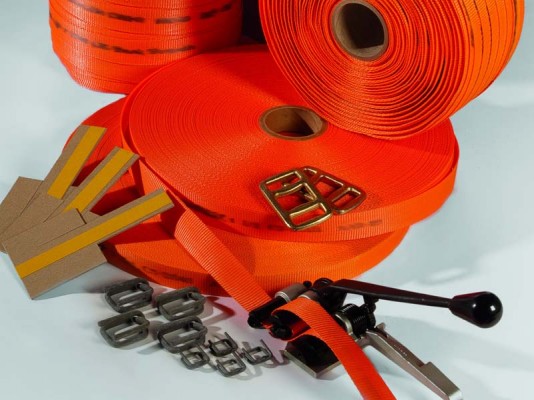
Tex-Steel™: A Cord Strap as Strong as Steel
Why You Should Use Rubber Friction Mats to Secure Your Shipments
AAR Approved Method – Threading Tex-Steel into Boxcar Wall Anchors [VIDEO]

3 Factors that Impact the Air Pressure in Your Dunnage Bags

In this blog, I will discuss the 3 main factors that will impact the air pressure in your air dunnage bags. These potential issues apply to not only our dunnage bags at Complete Packing Systems, but to dunnage bags industry-wide.

Luckily, performing simple air pressure checks will prevent excessive movement, damage, and injury. This is one thing you don’t want to rush.

A lot of the time, people are busy and may cut corners to save a few minutes. For example, many people know of the “30 minute rule” – but they may neglect it. After your initial inflation, you must always check the pressure again after 30 minutes. If the pressure is low, you must top up your bags.

1. Stretching

Although you may think the loss of pressure would be caused by a hole, this is often not the case.

Dunnage bags are made from a woven synthetic outer shell and a thick plastic inner bladder. When filled to the recommended PSI, the air pressure will stretch the bladder after 30 minutes and cause a pressure drop. This is when you should top up your bags back to the original PSI.

2. Weather

Weather, in many cases, plays a large role in how dunnage air bags perform. Cold weather will reduce air pressure, much like in your car tires. In hot weather, the bags could expand past their recommended PSI.

Shippers must be aware of the weather their shipments will be experiencing and adjust accordingly.

3. Altitude

Finally, I must mention altitude. Recently, I drove from Las Vegas, NV to the Grand Canyon. This was an increase of nearly 5,000 feet above sea level. A bag of chips that I hadn’t opened yet was lying on the floor of my car. When I arrived at the Grand Canyon, the bag of chips looked as if it would burst at any moment.

This story is a good reminder: if you are shipping from a lower area to a high altitude or vice versa, you must ensure you take altitude into account when assessing your dunnage bags.

Summary

Dunnage bags are most effective when they are filled to the recommended PSI. You can save your shipments from moving around and becoming damaged by watching out for these simple factors that affect your bags’ air pressure.

>> Complete Packaging Systems can help you with your shipments. Our goal has always been to ensure our customers’ products arrive safely and damage free. Just give us a call at 1-800-858-8800!


Like this? You might also like:
Avoid These 4 Mistakes! Prevent Damage to Your Air Dunnage Bags
Cyclone™ Dunnage Air Bags: Inflation Technology
Why You Should Use Rubber Friction Mats to Secure Your Shipments

Why You Should Use Rubber Friction Mats to Secure Your Shipments

I would like to start out this blog by addressing a problem: the many terms to describe rubber friction mats, such as “anti-skid mats”, “rubber transportation mats”, and various brand names. Our industry refers to them as rubber friction mats. I encourage you to do the same.

If you had the choice between using wood bracing or rubber friction mats to secure your shipment, which would you choose?

Many who have had the pleasure of using friction mats would say it’s no contest; they would choose friction mats for their anti-skid needs.

It is important for companies to abide by the railroads’ methods of securing loads. However, we are here to tell you that wood bracing is not always the answer and can be replaced in many situations. This would save your company the cost of wood, nails, energy, and time, along with providing a better, safer workplace for your employees.

By using our Load-Secure™ Friction Mats, you can easily secure your loads and keep them from shifting during transit – with no need for nailing, gluing, or constructing dunnage. Simply lay down the suggested mats underneath your shipment and let the product do its job.

As part of an effective load plan, rubber friction mats almost always eliminate the need for wood bracing. These products have been tested and approved by the Association of American Railroads (AAR) for use, but not all rail carriers are ready to change. In certain situations, wood bracing is still used but we urge you to ask why.

Why use wood bracing when something more cost-effective and efficient is available? Load-Secure products eliminate a potentially dangerous work environment. There is no loss of time due to injury from hammers, nails, or saws.

Rubber friction mats meet the North American Cargo Securement Standard. Friction mats don’t damage the rail carrier’s floors, and they save your company from the frustrations of wood bracing.

Many industries can benefit from replacing wood bracing with friction mats. Manufacturers working to produce varied commodities including metals, forest products, roll paper, glass, pharmaceutical, and even the food industry use Load-Secure™ products.

Free yourself from the old ways of load securement. You’ll be glad you did.

>> Need help with your cargo securement plan? Want to order our Load-Secure™ products? Contact us today!

Like this? You might also like:
Avoid These 4 Mistakes! Prevent Damage to Your Air Dunnage Bags
What are the Most Common Types of Damage to Paper Rolls in Railcar Transit?
Tex-Steel™: A Cord Strap as Strong as Steel

Avoid These 4 Mistakes! Prevent Damage to Your Air Dunnage Bags

Air dunnage bags are applied as a preventative measure, ensuring your products/shipments arrive to their destination unscathed and safe. Due to the bags’ strength and resilience, many believe they cannot be harmed or compromised.

Unfortunately, this leads to the dunnage bags being applied and handled incorrectly, leading to potential failure. Synthetic airbags are comprised of a polyethylene woven outer shell and an interior plastic air bladder.

In today’s blog, I will go over some of the errors, misconceptions, and habits occurring in the field that contribute to airbag damage. Armed with this knowledge, you’ll be able to get the most from your dunnage bags.

No product is 100% guaranteed never to fail, but about 99% of the failure we see is caused by exterior outer fabric abrasion. Exterior abrasion is essentially a stretch or tear caused by an outside force acting on the bag, often creating an escape for the trapped air. Since the outer shell is woven and not a solid piece this causes the bags to deflate, sometimes at a rate not noticeable over a few minutes.

4 Ways to Avoid Exterior Abrasion Damage to Your Air Dunnage Bags 

  1. Keep bags in their box until they are needed.
  2. Make sure bags are never left unattended or on the ground where lift trucks could run them over.
  3. Ensure there are no nails, splinters, or sharp edges making contact with the dunnage bags.
  4. If needed, use honeycomb dunnage products or corrugated sheets to buffer the bags from sharp edges. This will ensure the bags maintain air pressure and your product arrives safely.

Avoid these four simple mistakes and your dunnage bags will perform as intended, ensuring your shipments arrive safely and damage-free!

Lastly, Complete Packaging Systems offers comprehensive training throughout North America for customers purchasing our products. We will help you to stay compliant within the Association of American Railroads (AAR), rail carriers, and other governing bodies. You will become more efficient and learn how to get the most out of your cargo securement products. (Click here to contact us for further details on our training programs.)

>> For more information about our Cyclone™ dunnage bags or to order products, please contact us today.

Like this? You might also like:
Cyclone™ Dunnage Air Bags: Inflation Technology
What are the Most Common Types of Damage to Paper Rolls in Railcar Transit?
Tex-Steel™: A Cord Strap as Strong as Steel

Cyclone™ Dunnage Air Bags: Inflation Technology

In our industry, bringing new and exciting technology to market is a daunting task. Many people in purchasing roles and at dock level like their old technology because it works for them. Unfortunately, most inflation systems that we see out in the market are bulky, heavy, and not designed for the human hand. This ergonomic issue, combined with long fill times, puts an unnecessary strain on the user.

People need education about the cheaper, more reliable, and faster ways to fill dunnage air bags. And weÂ’re taking the challenge head on through innovation, ergonomics, and speed. To that end, our new inflators are lightweight and designed with the end user in mind.

Speed is a large factor at the dock level. We aim to cut the time filling air bags by nearly 2/3. We have performed tests with industry-leading bags (all of them the same size and volume,) and our inflation system was 66% faster.

Along with being the fastest tool on the market, it is also very accurate. Each tool comes with a digital PSI gauge. Once again, this saves time by not having to disconnect the inflator to use a secondary measuring tool.

Using old, outdated inflation technology out of habit only makes filling dunnage bags more difficult and time-consuming. With new technology available, there is no need to put the extra strain on users and waste valuable time. Start improving your processes now with our line of ergonomic, speedy inflators.

Benefits

  • Lightweight and durable
  • Accurate PSI reading
  • Ergonomic grip
  • 66% faster than traditional air dunnage inflators
  • No unnecessary strain on the user
  • Easy-click button
  • Cheaper than conventional systems

>> For more information about our Cyclone™ inflation technology, please contact us today!


Like this? You might also like:

AAR Approved Method – Threading Tex-Steel into Wire Buckle [Video]
AAR Approved Method – Threading Tex-Steel into Boxcar Wall Anchors [Video]
Tex-Steel™: A Cord Strap as Strong as Steel